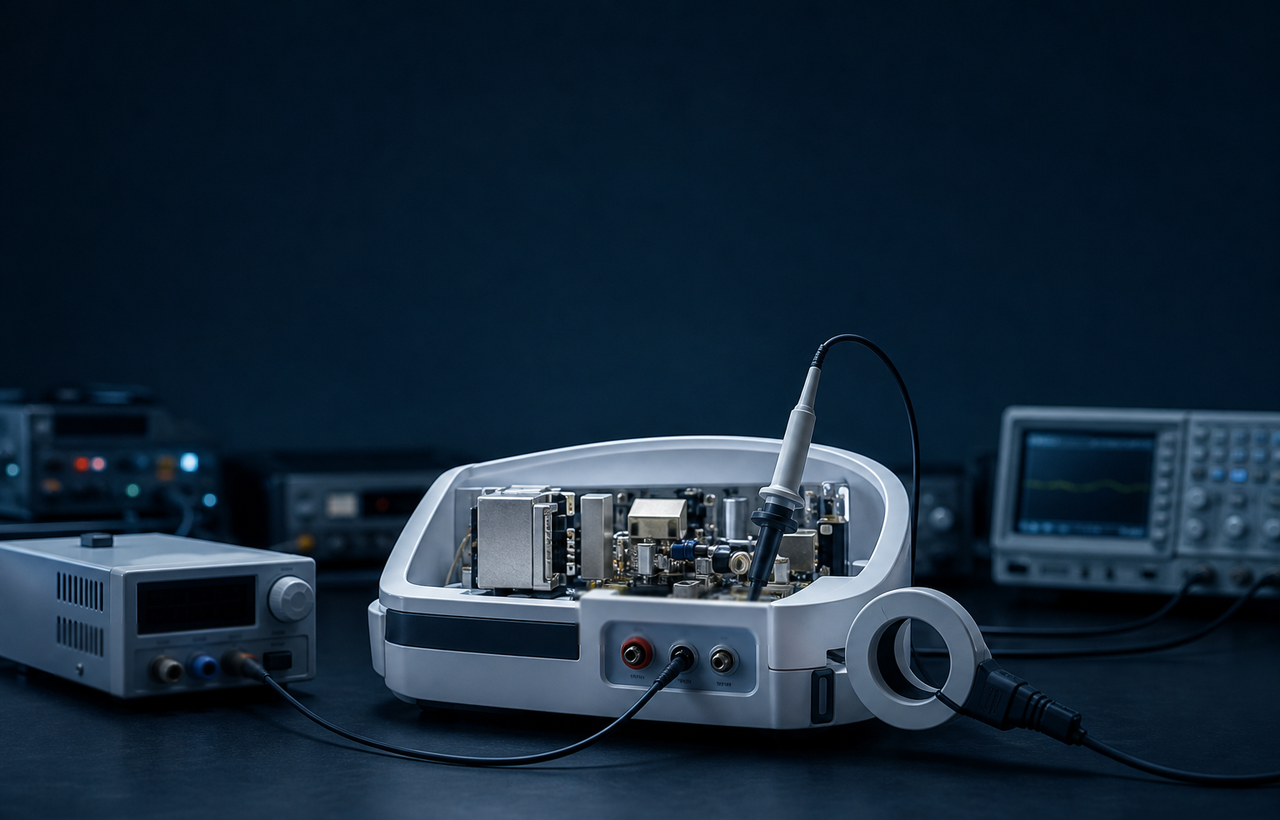



Safety isolation and leakage requirements
Medical equipment design must meet strict isolation and leakage current limits. Measurement tools need high common-mode rejection and safe-rated probing.

Precision voltage and current measurement for medical power supplies, diagnostic imaging, and therapeutic equipment with high isolation, low noise, and reliable signal fidelity.
Medical equipment design must meet strict isolation and leakage current limits. Measurement tools need high common-mode rejection and safe-rated probing.
Diagnostic imaging and monitoring equipment operate with low signal levels, making them sensitive to probe-induced noise and interference.
Medical device development spaces are often dense with instrumentation, requiring flexible probing and compact sensor form factors.
Medical electronics demand rigorous safety, isolation, and signal-integrity testing across power supply, imaging, diagnostic, and therapeutic system development.

Measurement tools must remain dependable under demanding development and validation conditions.

The measurement chain is designed for practical lab, production, and troubleshooting environments.

Selection guidance, usage support, and maintenance services help reduce lifecycle friction.

Verify output stability, isolation voltage, leakage current, and transient response for medical-grade power supplies.

Capture high-voltage drive signals and current waveforms in ultrasound, X-ray, and MRI subsystem development.

Measure low-level analog signals with minimal noise injection to verify front-end acquisition performance.

Evaluate isolation, leakage, and output accuracy for electro-surgical, RF ablation, and stimulation devices.